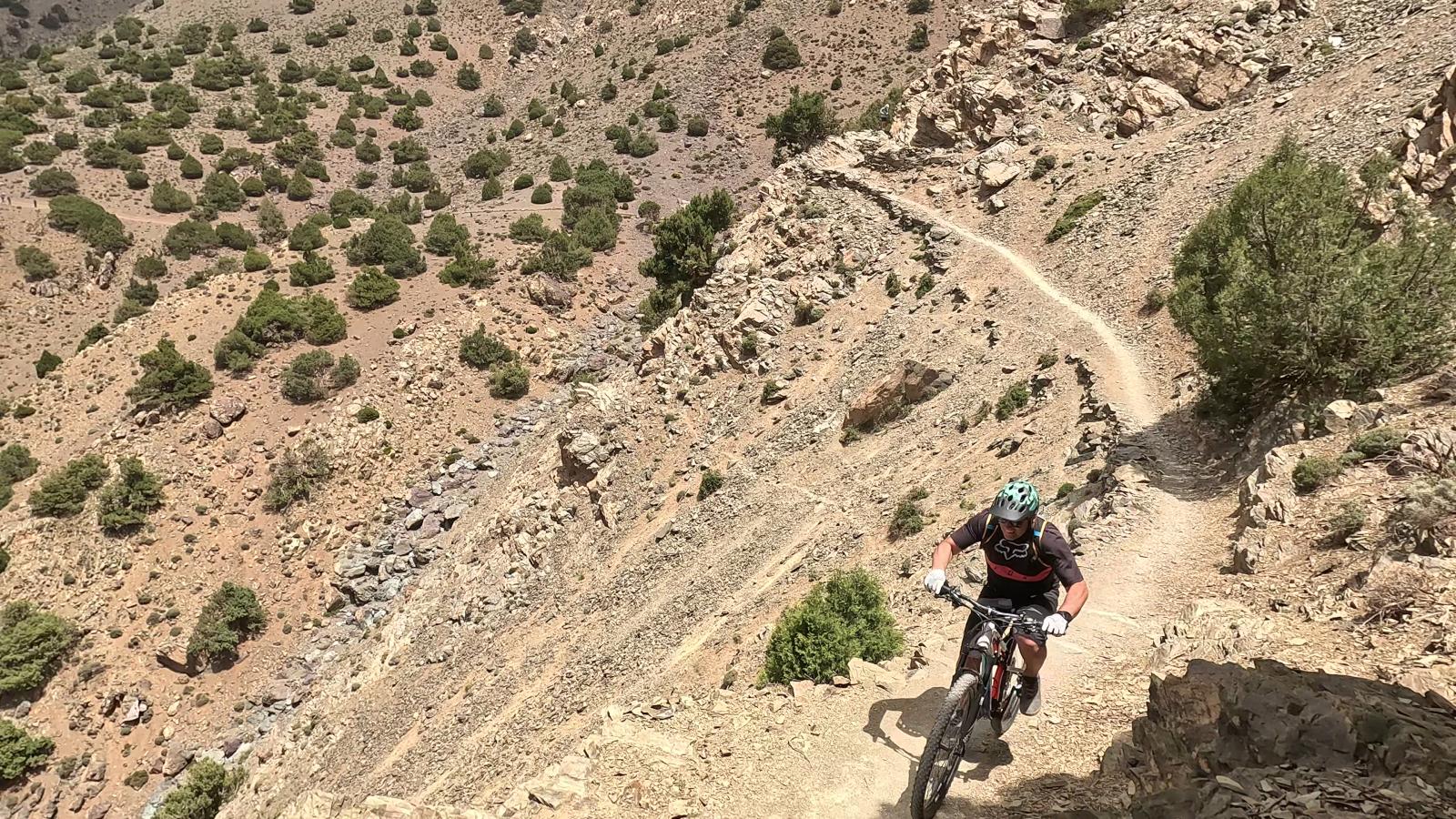
You do not need to speak the language to enjoy a mountain bike trip in the High Atlas. Your guide will translate, and many people in the villages speak some Arabic, French or even English. But a few words of the local language go a remarkably long way.
Say "azul" to an old man sitting by the path, and watch his face light up. Thank your host with "tanmmirt" after dinner, and you will get a smile you will remember. People in the mountains rarely hear visitors try their language, and they notice.
Which language is spoken in the High Atlas?
Morocco's Amazigh (Berber) languages are often grouped under the name Tamazight. In the High Atlas around Imlil, Ouirgane and the Toubkal region, the local variety is Tashelhit (also written Tachelhit or Shilha). It is an official language of Morocco alongside Arabic, and you will see its alphabet, Tifinagh, on road signs and public buildings.
Pronunciation and some words vary from valley to valley, so do not worry about being perfect. Effort matters far more than accuracy. Read more in Amazigh culture explained.
Greetings
- Azul (a-ZOOL): hello. The universal Amazigh greeting.
- Labas? (la-BAS): are you well? Also used across Morocco in Arabic.
- Labas, lhamdulillah : I'm fine, thank God. The standard answer.
- Manzakin? (man-za-KEEN): how are you? A common Tashelhit greeting.
- Ar tufat : see you tomorrow / goodbye (literally "until morning").
You will also hear and can use the Arabic salam alaykum (peace be upon you), answered with wa alaykum salam.
Polite essentials
- Tanmmirt (tan-MEER-t): thank you. Probably the most useful word on this page.
- Iyyah : yes.
- Uhu : no.
- Afak : please (also common in Moroccan Arabic).
- Smh iyi : excuse me / sorry.
Food and tea
- Aman : water.
- Atay : tea. You will hear this word a lot.
- Aghrum (sometimes written agrum): bread.
- Tamment : honey.
- Tiremt : a meal.
- Ifulki / Ihla : good, delicious (usage varies by valley; your guide will tell you the local favourite).
- Safi : enough, that's fine. Useful when your host keeps filling your plate.
Read mint tea and Moroccan hospitality to understand the tea ritual.
On the trail
- Abrid : path, road.
- Adrar : mountain. The Atlas is often called "Adrar n Dern" in old texts.
- Asif : river. You will see it in place names like Asif n Imlil.
- Taddart : house.
- Tiddukla : friendship, association.
- Ifulki : fine, beautiful.
Many High Atlas place names make more sense once you know a few roots. "Ait" means "people of" or "sons of", so Ait Mizane means the people of Mizane. "Tizi" means a mountain pass, so Tizi n'Tichka is the Tichka pass. "Ighil" means a ridge or hill.
Numbers (handy at the souk)
In practice, most numbers in markets are said in Moroccan Arabic or French. Your guide will help. If you want to try, Tashelhit numbers are yan (1), sin (2), kraḍ (3), kkuẓ (4), smmus (5). Saying "yan, sin, kraḍ" to children in a village is a guaranteed laugh. Read weekly souks of the High Atlas.
Tips for using your new words
- Start with azul and tanmmirt. If you learn nothing else, learn these two.
- Ask your guide to teach you the local version of words. Guides love doing this, and it makes for great conversations on long climbs.
- Write words down on your phone and practise at each village stop.
- Do not be shy. Mispronouncing a word is never rude. Not trying sometimes feels a little distant.
- Learn from children. They will correct you, laugh with you and teach you more words than any book.
A few words about Tifinagh
The Tifinagh alphabet has ancient roots and has been revived as a symbol of Amazigh identity. The yaz symbol, ⵣ, which looks like a person with raised arms, represents the "free man" and appears on the Amazigh flag. Spotting it on signs and in villages is a nice way to connect with the culture as you ride.
Language as a key
Learning a few words is not about becoming fluent. It is about showing respect and opening a door. In the High Atlas, that door often leads to tea, bread, laughter and a story you will tell for years. A simple "azul" is where it starts.
Want to practise on the trail? Read about our local guides, who are happy to teach you.