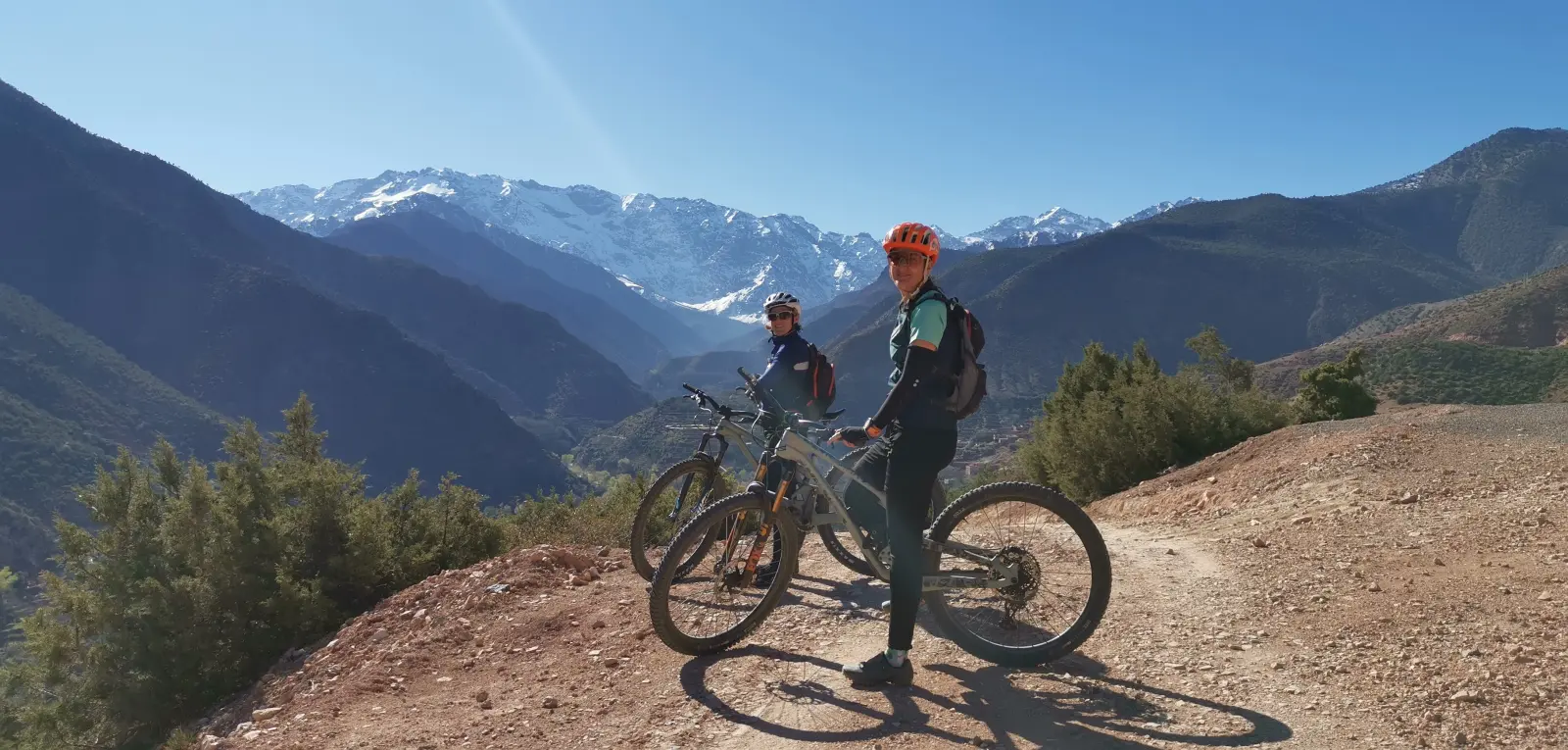
In the High Atlas, the nearest bike shop is in Marrakech, often two hours or more away. Village mechanics are brilliant at fixing mopeds and water pumps, but they rarely have a tubeless valve or a derailleur hanger for your bike. That is why every rider should carry a small repair kit, and why our guides carry a much bigger one.
Here is what we recommend, and why.
What our guides carry
On every guided ride, the guide carries a full trail kit, and the support vehicle carries a workshop on wheels: spare wheels, tyres, brake pads, chains, derailleurs, cables, a track pump and often spare bikes. So on a guided trip, you do not need to carry everything. But a few personal items save time and help on stretches where the vehicle cannot follow.
Your personal kit
Fit it in a small saddle bag, frame bag or the bottom of your backpack.
- Spare tube: even if you run tubeless. It is the backup when a plug will not hold.
- Tyre levers: two strong plastic levers.
- Mini pump or CO2 inflator: a pump is more reliable over many days. CO2 cartridges are not always easy to find in Morocco or to carry on planes.
- Multi-tool: with the hex keys and Torx bits that fit your bike, plus a chain tool.
- Tubeless plugs: a plug kit fixes most small cuts in a minute.
- Quick link: a spare chain link that matches your chain's speed.
- Spare derailleur hanger: specific to your frame. This is the part most often broken and hardest to find.
- Zip ties and electrical tape: for temporary fixes of almost anything.
- A tyre boot: a piece of strong material to patch a large sidewall cut. An energy bar wrapper works in an emergency.
- Small rag and gloves: chains are dirty.
If you bring your own bike, add these to your main luggage
- Spare brake pads for your specific brakes
- Tubeless sealant, a spare valve and a valve core tool
- A spare tyre if you run an unusual size
- A shock pump for your suspension
- Spare cleats if you ride clipless
- Any special tools your bike needs, such as a bottom bracket or cassette tool
- Chain lube for dry and dusty conditions
Many bike parts are hard to find outside Marrakech, and some are hard to find even there. Our guide on bring your own bike or rent? explains why many riders prefer to rent.
The most common problems on Atlas trails
Punctures and cuts. Sharp rocks and thorny bushes are the main cause. Tubeless tyres with fresh sealant prevent most problems. Check pressures daily.
Bent derailleur hangers. A rock strike or a fall can bend the hanger, causing poor shifting or worse. Carry a spare and know how to fit it.
Worn brake pads. Long, dusty descents eat pads quickly. Check them every day on a multi-day trip.
Loose bolts. Constant vibration on rocky trails loosens things. A quick check each morning catches most problems.
Dry, dusty chains. Dust and grit wear chains fast. Clean and lube regularly, using a dry lube.
Snapped chains. Less common, but it happens on steep climbs. A quick link and chain tool will get you home.
Fixes every rider should know
Learn these at home before your trip. A short session with a local bike shop or a few videos will do.
1. Fixing a puncture with a tube: removing the tyre, finding the cause, fitting a tube and inflating it.
2. Plugging a tubeless tyre: using a plug tool on a small cut.
3. Replacing a derailleur hanger: removing the derailleur, swapping the hanger and checking alignment.
4. Fixing a broken chain: removing the broken link and fitting a quick link.
5. Adjusting brakes: centring a rubbing calliper.
6. Checking bolts and torque: stem, bars, seat post and axles.
Daily bike check
Our guides check every bike each morning, but get into the habit yourself:
- squeeze both brakes firmly
- spin the wheels and look for wobbles or rubbing
- check tyre pressure and look for cuts
- check that the axles are tight
- run through the gears
- wipe and lube the chain if it is dry
Read our safety rules for more on how we look after bikes and riders.
Tubeless: our strong recommendation
If you bring your own bike, set it up tubeless with fresh sealant before you travel. Thorns and sharp rocks in Morocco cause many slow punctures that tubeless sealant fixes without you noticing. Top up sealant before the trip, as it dries out over time and faster in hot, dry climates.
Weight versus safety
You do not need to carry a workshop on your back. Keep your personal kit light and practical, and rely on the guide and support vehicle for bigger repairs. On self-guided or independent rides, carry more, and always tell someone your route.
A note about the vehicle
On guided trips, the support vehicle meets the group at planned points. Between these points, you may be on trails where the vehicle cannot go. That is when your personal kit matters most. Your guide will tell you which sections are remote so you can be prepared.
Pack it before you forget
Add the repair kit to your packing list, and check it a week before you fly. If you are flying with your bike, remember that CO2 cartridges and some lubricants may be restricted by airlines. Read how to pack and fly with your bike for details.
A good repair kit is like insurance. You hope you will not need it, but when a rock slices your tyre halfway down a valley, you will be very glad it is there.