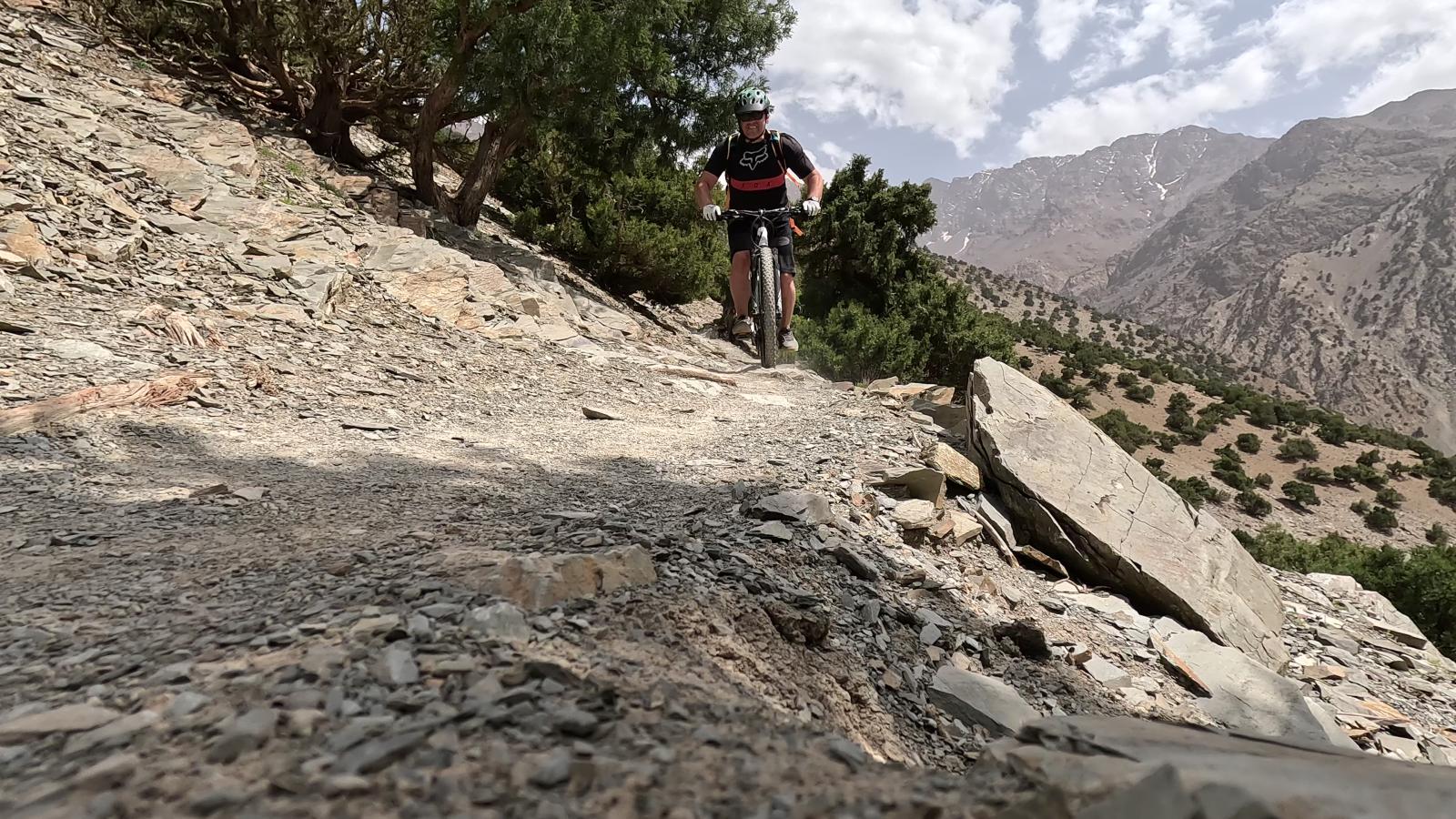
You have booked the trip, the flights are confirmed and the Atlas is eight weeks away. Now what? This plan is designed for regular riders who want to arrive fit enough to enjoy every day, not just survive them. It is not a racing plan. It is built around what Atlas riding really demands: long climbs at a steady pace, rocky descents and several big days in a row.
Adjust it to your life. If you miss a session, do not try to catch up by doubling the next one. Consistency beats heroics.
A note on health: if you have any medical condition, are returning from injury or have not exercised for a long time, check with your doctor before starting a new training plan.
What you are training for
A typical moderate Atlas day is 30 to 45 km with 800 to 1,200 metres of climbing, spread over five to six hours with stops. Climbs are often long rather than steep. Descents are rocky and demand concentration. And you will do this four to six days in a row, at altitude. So the plan focuses on four things:
- Endurance: being comfortable on the bike for four to five hours
- Climbing: holding a steady effort for 30 to 60 minutes uphill
- Back-to-back days: riding well on tired legs
- Skills and strength: staying relaxed and in control on rough ground
The weekly structure
Each week has three or four sessions:
- A long ride at a comfortable, conversational pace, ideally off-road and hilly
- A climbing session with repeated efforts uphill
- A shorter recovery or skills ride
- A strength session of 20 to 30 minutes at home or in the gym
If you have time for only three sessions, keep the long ride, the climbing session and the strength work.
Weeks 1 and 2: Build the base
- Long ride: 2 to 2.5 hours at an easy pace.
- Climbing: find a hill that takes 5 to 8 minutes to climb. Ride up it 3 to 4 times at a steady, firm effort, recovering on the way down.
- Recovery ride: 45 to 60 minutes, very easy.
- Strength: squats, lunges, glute bridges, planks and push-ups. Two to three sets of each.
The aim is simply to get into the habit. Do not worry about speed.
Weeks 3 and 4: Add time and climbing
- Long ride: 3 to 3.5 hours, with as much climbing as your local area allows.
- Climbing: longer efforts. 3 to 4 climbs of 10 to 15 minutes, or repeats of a shorter hill. Stay seated, spin a light gear and keep your breathing controlled.
- Skills ride: 1 hour on local trails. Practise standing on the pedals over rough ground, braking before corners and riding small steps.
- Strength: add single-leg exercises such as step-ups and split squats, and side planks for core stability.
Week 5: First back-to-back weekend
This is where the plan starts to look like a trip.
- Saturday: 3 to 3.5 hours with plenty of climbing.
- Sunday: 2 to 2.5 hours, even if your legs feel heavy.
- Midweek: one climbing session and one strength session.
Notice how you feel on day two. Learning to ride steadily on tired legs is one of the most valuable things you can practise.
Week 6: Peak volume
- Saturday: 4 to 4.5 hours, the longest ride of the plan. Include long climbs and rough descents if you can.
- Sunday: 2.5 to 3 hours.
- Midweek climbing: 2 to 3 climbs of 20 minutes at a steady effort, the kind you will meet on the way to an Atlas pass.
- Strength: keep it going, but do not increase the load.
Practise eating and drinking on the bike during the long ride. Find out which snacks work for you. See staying hydrated and fuelled.
Week 7: Sharpen up
- Long ride: 3 to 3.5 hours with your trip kit: the same shorts, shoes, backpack and hydration system you plan to use in Morocco.
- Climbing: a shorter session with 4 to 5 efforts of 5 minutes, slightly harder.
- Skills: a session focused on descending. Read our descending tips before you go out.
- Strength: lighter, focusing on mobility and core.
Week 8: Taper and rest
The final week is about arriving fresh, not fitter. Fitness gains from this week will not show up in time, but fatigue will.
- Two or three short rides of 1 to 1.5 hours, including a few short efforts to keep your legs awake.
- No new strength work. Gentle stretching and mobility instead.
- Sleep well, eat well and pack calmly.
- Service your bike if you are bringing it, at least a week before you fly.
No mountains nearby?
Many riders live somewhere flat. You can still prepare well:
- Use headwinds and long rides to build endurance.
- Indoor training works brilliantly for climbing. Long seated efforts of 10 to 20 minutes at a steady pace mimic Atlas climbs well.
- Stairs, hiking and step-ups build climbing strength.
- Practise skills in local woods, parks or bike parks, even if they are small.
Altitude preparation
You cannot train for altitude at sea level, but a strong aerobic base and good pacing help a lot. Read riding at altitude for practical tips on acclimatising once you arrive.
Common mistakes
- Doing too much too soon. Build gradually, or you will be injured or exhausted.
- Only training on the road. Off-road riding uses different muscles and skills.
- Ignoring the upper body. Rocky descents are hard on arms, shoulders and core.
- Training hard in the last week. Rest is part of the plan.
When you arrive
Ride easy on the first day, even if you feel strong. Let your body adapt to the altitude and the terrain. Our climbing tips will help you pace the long ascents. If you followed this plan, you will be ready to enjoy the mountains from the first pedal stroke to the last descent.