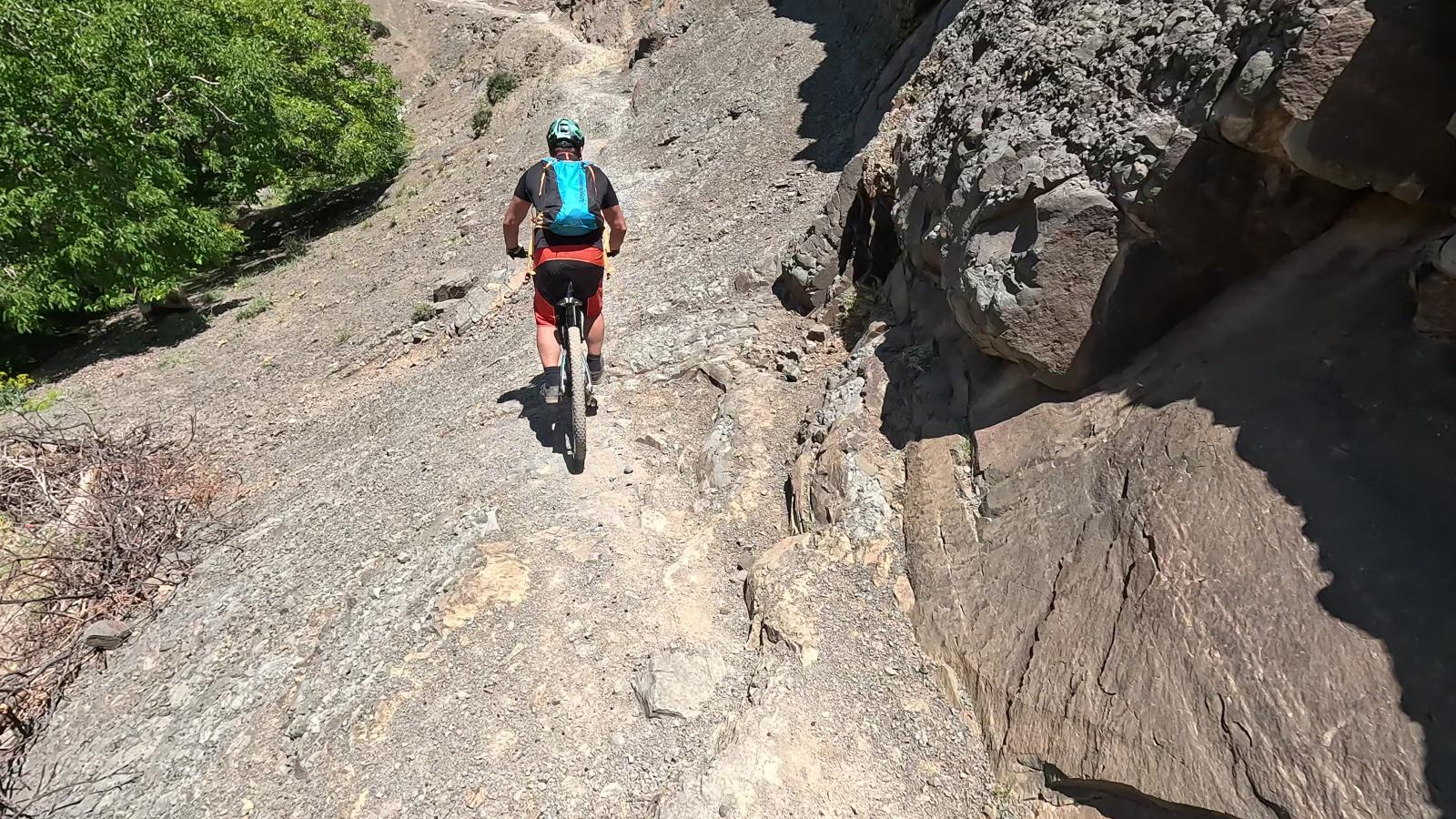
Most riders arrive in Morocco ready for rocks. What surprises them is the gravel. After months without rain, many Atlas trails are covered with a layer of loose stones, grit and fine dust. It can feel like riding on marbles, especially in corners and on steep descents. The good news is that loose ground is a skill, and it improves quickly with a few simple techniques.
Why loose ground feels so strange
On packed dirt, your tyres bite into the surface. On loose gravel, the top layer moves under the tyre, so the bike drifts slightly instead of following your steering exactly. In deep dust, the front wheel can push wide or sink. Your instinct is to tense up and brake hard. That is usually the worst thing to do.
The aim is not to stop the bike moving around. It is to stay relaxed and keep it moving in roughly the right direction.
Body position: light and centred
- Stand on the pedals, knees and elbows bent, as on any rough descent.
- Keep your weight centred, with a little more weight on the front wheel than feels natural. A front wheel without weight loses grip.
- Hold the bars firmly but loosely. Let the bike move beneath you.
- Look ahead, not at the ground right in front of you.
A relaxed body lets the bike find its own grip. A stiff body fights every movement and makes small slides into big ones.
Braking on loose surfaces
Braking is where most people come unstuck.
- Brake early. Do most of your slowing on the firmest part of the trail before the loose section.
- Brake smoothly. Squeeze, do not grab. Sudden braking locks the wheels.
- Use both brakes. The front brake is powerful but needs a delicate touch on gravel. The rear helps stabilise the bike.
- Release in corners. Try to finish braking before you turn. Braking while leaning increases the chance of a slide.
- Avoid skidding. A skidding tyre has less grip than a rolling one and damages the trail.
If you feel the front wheel start to slide, ease off the front brake and let the wheel roll. It will usually find grip again.
Cornering
- Slow down before the corner, on the straight.
- Look through the corner to where you want to go.
- Lean the bike more than your body, keeping your weight over the tyres.
- Drop your outside pedal and press your weight into it. This pushes the tyres into the ground.
- Choose the line with the most packed dirt, often the outside of the turn on mule paths.
- Accept a small drift. A controlled slide is normal on loose ground.
Climbing on gravel
Loose climbs are tricky because the rear wheel spins easily.
- Stay seated to keep weight over the rear tyre.
- Use an easier gear and pedal smoothly. Stamping on the pedals causes wheel spin.
- Lean slightly forward to stop the front wheel lifting on steep pitches.
- Look for patches of packed ground, even if they are a little off the obvious line.
- If the wheel spins and you stop, it is often easier to walk a few metres to firmer ground than to restart on loose stones.
Our climbing tips cover pacing on long ascents.
Dust
Dust is a feature of dry-season riding in Morocco. A few tips:
- Leave space. Ride a few seconds behind the rider in front so you can see the trail and breathe clean air.
- Protect your eyes. Clear or light-tinted glasses keep dust out without making shaded sections too dark.
- Cover your nose and mouth. A buff helps on very dusty stretches.
- Watch for hidden holes. Deep dust can hide ruts and rocks. Slow down when you cannot see the ground.
Tyres and set-up
The right tyres make a big difference.
- Width: wider tyres, around 2.3 to 2.5 inches, float better on loose ground.
- Tread: tyres with open, well-spaced knobs grip better in loose conditions than fast-rolling tyres with small knobs.
- Pressure: lower pressures give a bigger contact patch and more grip. Tubeless set-ups let you run lower pressures without pinch flats. Ask your guide to check pressures before the first ride.
- Suspension: a slightly softer set-up helps the tyres follow the ground.
If you are renting, good rental bikes come with suitable tyres. If you bring your own bike, consider fitting more aggressive tyres for the trip. Read bring your own bike or rent?.
Gravel on e-bikes
E-bikes are heavier and have more power, which can make wheel spin more likely on loose climbs. Use a lower assist mode and smooth pedalling. On descents, the extra weight can feel stable, but it takes longer to stop, so brake earlier.
Practice makes calm
The best way to get comfortable on loose surfaces is to practise in a safe place: a quiet gravel track or a flat car park with some grit. Practise braking at different speeds, gentle turns and controlled slides at low speed. It helps your brain accept that a little movement is normal.
Respect the trail
Skidding and riding off the line both damage dry trails, which are slow to recover without rain. Brake smoothly, stay on the existing path and avoid cutting corners. Our post on responsible mountain biking explains why it matters.
Loose ground can feel unnerving at first. Within a couple of days, most riders find their rhythm and start enjoying the gentle drift of the tyres in the corners. Combine these tips with our descending techniques, and you will be ready for almost anything the Atlas has to offer.